
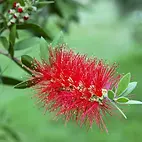
Stiff-leaved Bottlebrush
Callistemon linearis
NEMBA category
English: Stiff-leaved Bottlebrush, Narrow-leaved Bottlebrush, Stiff Bottlebrush
Afrikaans: Perdestert
Misapplied or old scientific names: Callistemon rigidus, Metrosideros linearis, Melaleuca linearis
Callistemon linearis, often called the Stiff-leaved Bottlebrush or Stiff Bottlebrush, is a neat and upright evergreen shrub that's always ready to show off its brilliant red, fuzzy flowers, which look just like the brushes used to clean bottles! It's a more compact plant than some of its bottlebrush cousins, with stiff, long, very thin leaves that stand out. When summer arrives, it bursts into bloom with striking scarlet flower spikes that are a magnet for buzzing bees and colourful birds.

Have you got a better picture?
If you don't mind us using it, please upload it by clicking the Upload button below (you must be logged in to do this)
Origin:
Native to New South Wales, Australia.
Distinguishing features:
Stiff, upright habit: Tends to be a more erect and less weeping shrub compared to some other bottlebrush species.
Narrow, linear leaves: Leaves are noticeably long, thin (linear), and stiff, giving the plant a rigid texture.
Dense, bright red bottlebrush flowers: Cylindrical flower spikes, typically a vibrant scarlet, packed with prominent stamens.
Persistent woody fruit capsules: Small, woody, cup-shaped capsules that remain on the stems for a long time.
Overall appearance:
An evergreen, stiff, and bushy shrub with an upright growth habit. Its dense foliage and erect flower spikes contribute to its compact appearance.
Height:
Typically grows to between 2 and 3 metres tall, occasionally reaching up to 4 metres.
Width:
Usually spreads about 1 to 2 metres wide.
Leaves:
Simple, alternate, and distinctly linear (very narrow and long), often stiff and somewhat rigid to the touch. They are dark green, usually 4 to 10 centimetres long and only 1 to 3 millimetres wide. When crushed, they may have a slight aromatic scent. They are evergreen.
Flowers:
Vibrant scarlet red, densely packed in cylindrical spikes (resembling a bottlebrush) that are typically 5 to 10 centimetres long and about 4.5 to 6 centimetres in diameter. The showy part of the flower is the mass of long, prominent stamens. Individual flowers are small with inconspicuous petals. The plant is hermaphroditic, with both male and female parts in each flower.
Flowering season:
In South Africa, it primarily flowers in summer, typically from November to March, but can sometimes have sporadic blooms at other times of the year, especially in warm climates.
Fruits:
Small, hard, woody, cup-shaped capsules, about 7 millimetres in diameter. These fruits form in clusters along the older stems and are highly persistent, often remaining on the branches for several years after the seeds have been released.
Seeds:
Very small, fine, light brown to blackish seeds, about 1 to 1.5 millimetres long. They are released from the woody capsules and are primarily dispersed by wind.
Bark:
The bark is typically grey-brown, somewhat rough, and fibrous, especially on older stems and trunks.
Thorns:
This species does not have thorns.
Wood:
The stems are initially flexible but become woody and quite stiff with age, contributing to the plant's upright structure.
Roots:
Develops a fibrous root system that allows it to establish well in various soil conditions.
Soil type:
Prefers acidic to neutral, moist but well-drained soils. It is quite adaptable and can tolerate a range of soil types, including sandy or loamy soils.
Aspect:
Thrives in full sun for optimal flowering. While it can tolerate some partial shade, the best blooms and growth occur in sunny locations.
Ediblity:
Not considered edible for humans.
Toxicity:
Generally considered non-toxic to humans and pets. Like other Callistemon species, while its essential oils are not for consumption, there is no significant evidence of toxicity from the plant itself.
Uses:
Primarily cultivated as an ornamental shrub in gardens, parks, and urban landscapes due to its attractive, stiff foliage and striking red bottlebrush flowers. It is often used as a specimen plant, in hedges, or in mixed shrub borders. Its flowers are attractive to nectar-feeding birds (like sunbirds) and various insect pollinators, including bees and butterflies.
Ecology:
As an alien invasive plant in South Africa, Callistemon linearis has the potential to escape cultivation and naturalise in certain habitats. Like other Callistemon species, it can outcompete indigenous vegetation, especially in disturbed areas or along watercourses, forming dense stands that reduce local biodiversity. While its flowers provide nectar, its invasive growth can negatively impact the overall ecological balance of natural ecosystems. Its seeds are wind-dispersed, aiding its spread.
Distribution and habitat:
Widely cultivated across South Africa. While its NEMBA status might be less specifically detailed for Callistemon linearis compared to C. viminalis or C. citrinus, it is generally treated with caution as a non-indigenous Callistemon species. Many Callistemon species have invasive tendencies, particularly in areas with sufficient moisture. It can be found escaping into disturbed areas, roadsides, and possibly along watercourses in provinces where conditions are favourable, such as the Eastern Cape, KwaZulu-Natal, and Western Cape.
Derivation of name:
The genus name Callistemon comes from the Greek words 'kallos' (meaning "beautiful") and 'stemon' (meaning "stamens"), referring to the prominent, colourful stamens that form the "brush" part of the flower.
The species epithet linearis is Latin, meaning "linear" or "narrow," which directly describes the characteristic long, narrow leaves of this species.
Historical aspects:
Like many other Australian native plants, Callistemon linearis was introduced to gardens around the world, including South Africa, during the 19th and 20th centuries for its horticultural appeal. Its hardiness and attractive floral displays made it a popular choice. Its potential for invasiveness became a concern as it was observed to escape cultivated areas and establish itself in natural environments, similar to other members of the bottlebrush family.
NEMBA status:
Specific NEMBA category for Callistemon linearis might not be explicitly listed separately from C. viminalis or C. citrinus in all official documents. However, as a non-indigenous Callistemon species with invasive tendencies, it would generally fall under NEMBA regulations concerning alien invasive species. Due to its potential to escape cultivation and impact local biodiversity, it would likely be treated as either a Category 1b or Category 3 invasive species in certain regions, meaning its planting might be restricted or control might be required if it invades natural areas. It's important to check the most current provincial regulations.
Interesting facts:
Unlike its more "weepy" cousins, this bottlebrush stands up straight and proud, with stiff branches and leaves, giving it a very neat and tidy look!
Its leaves are so thin and straight, they look almost like pine needles, which is how it got its "Narrow-leaved" name!
Even though its flowers are a fiery red, they don't have a strong scent, preferring to just look gorgeous and attract pollinators with their vibrant colour.
Like other bottlebrushes, its flowers are mostly made up of colourful stamens, not petals, creating that amazing brush-like effect that gives the plant its fun name!
Friendly alternatives:

Common name
Scientific Name
Plant type:
Plant type
Plant family:
Plant family (derivation)