
Woolly Plectranthus
Coleus barbatus
NEMBA category
English: Woolly Plectranthus, Large-flowered Plectranthus, Indian Coleus, False Boldo, Bluewings, Forskohlii, Blue Spurge
Afrikaans: Bloubos
Old scientific names: Plectranthus barbatus
Misapplied scientific names: Coleus forskohlii, Plectranthus forskohlii
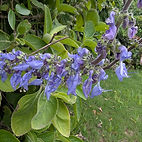
Coleus barbatus, sometimes still known by its old name, Plectranthus barbatus, is a rather hairy, bushy plant with broad, crinkly green leaves that smell quite strongly when you rub them, and then it erupts into tall, slender spikes of beautiful blue-purple flowers!
It's a tough, aromatic shrub that can form dense clumps, especially in disturbed areas. Its attractive flowers are a welcome sight, often appearing in the cooler months, but its ability to spread vigorously makes it an alien invader in many South African landscapes.


Have you got a better picture?
If you don't mind us using it, please upload it by clicking the Upload button below (you must be logged in to do this)
Origin:
Native to tropical East Africa, including countries like Ethiopia, Somalia, Kenya, and Tanzania, and also found in parts of India and Sri Lanka.
Distinguishing features:
Hairy, aromatic leaves: Broad, oval to heart-shaped leaves that are somewhat thick, crinkled, and densely covered in soft hairs. They release a strong, pungent, somewhat camphoric or medicinal smell when crushed.
Quadrangular stems: Stems are typically square in cross-section.
Blue to purple flowers in spikes: Small, two-lipped, blue or purplish flowers arranged in tall, narrow, upright spikes.
Thickened roots/tubers: Can develop fleshy underground tubers which aid in vegetative spread.
Overall appearance:
A bushy, upright, perennial shrub or subshrub, often with semi-succulent, hairy stems. It tends to form dense clumps due to its branching and ability to produce underground tubers.
Height:
Typically grows to between 1 and 2 metres tall, occasionally reaching 3 metres under ideal conditions.
Width:
Can spread 1 to 2 metres wide, forming dense thickets.
Leaves:
Simple, arranged in opposite pairs along the stems. They are broadly oval to ovate with a pointed tip and a somewhat rounded or cordate (heart-shaped) base. They are quite fleshy, somewhat wrinkled or crinkled, and covered in soft hairs, especially on the underside. They are typically green to grey-green, measuring about 5 to 15 centimetres long. When crushed, they emit a strong, pungent, distinctive aroma.
Flowers:
Small, tubular, two-lipped flowers, typically blue to purple (sometimes lavender or mauve). They are borne in dense, elongated, spike-like clusters (racemes or panicles) that are upright and appear at the tips of the stems. The upper lip of the flower is usually two-lobed, and the lower lip is boat-shaped. The plant is hermaphroditic, with both male and female parts in each flower.
Flowering season:
In South Africa, its main flowering period is typically in autumn and winter (around March to August), providing colour when many other plants are not blooming. However, it can flower sporadically at other times depending on local conditions and rainfall.
Fruits:
The fruit consists of small nutlets (schizocarps), typically 4 per flower, which are enclosed within the persistent calyx (the green cup-like structure beneath the petals).
Seeds:
The seeds are very small, smooth, and dark brown, contained within the nutlets. They can be dispersed by wind, water, or small animals.
Bark:
The young stems are green to purplish-brown, fleshy, and quadrangular (square in cross-section), often densely hairy. As the plant ages, the stems at the base can become slightly woody and less hairy, but it doesn't develop true bark like a tree.
Thorns:
This species does not have thorns.
Wood:
The stems are primarily herbaceous and semi-succulent, becoming somewhat woody at the base in older, mature plants.
Roots:
It has a fibrous root system that can extend laterally. It also produces fleshy, tuberous roots or rhizomes, which serve as storage organs and are crucial for its vegetative propagation, allowing it to resprout and spread easily.
Soil type:
Adaptable to a range of soil types, but prefers well-drained conditions. It can tolerate poor or disturbed soils and is relatively drought-tolerant once established.
Aspect:
Thrives in full sun to partial shade. In very hot climates, some afternoon shade can be beneficial.
Ediblity:
While some closely related Coleus species (like Coleus forskohlii) are used in traditional medicine and some cultures use similar leaves for culinary purposes, Coleus barbatus itself is not typically cultivated or consumed as a common food item. Caution should be exercised with consumption.
Toxicity:
Generally considered non-toxic for external or traditional medicinal use. However, ingestion of large quantities could potentially cause digestive upset due to its strong compounds. It contains diterpenoids such as forskolin, which have pharmacological properties, but this does not necessarily make the entire plant toxic in small amounts.
Uses:
Widely cultivated globally as an ornamental plant in gardens and landscapes for its attractive foliage and vibrant flowers, especially for adding colour during cooler months. It has also been used in traditional medicine, particularly in Ayurvedic practices (though often confused with or used interchangeably with Coleus forskohlii).
Ecology:
As an alien species in South Africa, Coleus barbatus can escape cultivation, particularly from garden waste. It is considered a potential environmental weed because it can establish itself in disturbed areas, roadsides, and open woodlands, forming dense clumps that outcompete indigenous vegetation. Its ability to spread vegetatively via stem fragments (which root easily) and its fleshy underground tubers contributes significantly to its invasive success, allowing it to rapidly colonise new areas and displace native plants. While its flowers provide nectar for insects, its overall impact as an invader is negative for native biodiversity.
Distribution and habitat:
Widely cultivated in gardens throughout South Africa. It has naturalised and is found escaping cultivation in various provinces, particularly in warmer, higher rainfall areas, including KwaZulu-Natal, Eastern Cape (where it is seen in disturbed areas and along roadsides, including around Kenton-on-Sea), Mpumalanga, and Limpopo. It invades disturbed sites, roadsides, forest margins, and open woodlands.
Derivation of name:
The genus name Coleus comes from the Greek word 'koleos', meaning "sheath," referring to the way the stamens (the pollen-producing parts of the flower) are united and appear to be sheathed at their base.
The species epithet barbatus is Latin for "bearded," referring to the hairy nature of the plant, especially the hairy flowers and stems.
Historical aspects:
Coleus barbatus has a long history of cultivation in various parts of the world, both as an ornamental and for its traditional medicinal uses. Its taxonomic classification has been a subject of change; for many years, it was known as Plectranthus barbatus. Recent molecular studies have led to the reclassification of many Plectranthus species, including this one, into the genus Coleus, reflecting a more accurate understanding of their evolutionary relationships.
NEMBA status:
Not specifically listed as a declared invasive species (Category 1a, 1b, or 2) in the NEMBA regulations. However, as a non-indigenous species that does naturalise and can form dense stands, it is often considered an environmental weed that requires management where it escapes into natural areas. Its sale and planting might be restricted in some contexts, or it may fall under broader "Category 3" principles for alien species that are not allowed to spread from properties. It is important to check the most current local environmental regulations as specific provincial or municipal rules may apply.
Interesting facts:
This plant used to be known by a completely different scientific name, Plectranthus barbatus! It's had a bit of a scientific identity crisis, but DNA tests have confirmed it's truly a Coleus.
If you rub its leaves, you'll be treated to a surprisingly strong, pungent smell – some people say it's a bit like Vicks VapoRub or camphor!
Even though it likes warmer weather, this plant often puts on its best flower show in autumn and winter, bringing a splash of blue and purple to the garden when other plants are taking a break.
It's a bit of a tough cookie: if a piece of its stem breaks off and lands on the ground, it can often grow into a whole new plant, making it a very efficient spreader!
Friendly alternatives:

Common name
Scientific Name
Plant type:
Plant type
Plant family:
Plant family (derivation)