
Forget-me-not-tree
Duranta erecta
NEMBA category
English: Forget-me-not-tree, Pigeon berry, Golden Dewdrop
Misapplied or old scientific names: Duranta plumieri, Duranta repens
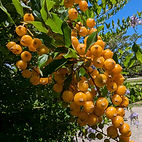
Evergreen or semi deciduous shrub or small tree. Flowers white, pale mauve or purple. The orange, berry-like fruits are borne in profusion and are poisonous.


Have you got a better picture?
If you don't mind us using it, please upload it by clicking the Upload button below (you must be logged in to do this)
Origins: Mexico, the Caribbean, Central America and much of South America
Overall Appearance: Duranta erecta is a fast-growing, evergreen shrub or small tree, often with a sprawling or weeping habit. It can reach heights of up to 6 metres and spread equally wide.
Leaves: Leaves are simple, opposite, and ovate (egg-shaped) with a pointed tip. They are typically 2.5 to 7.5 cm long with a serrated or smooth margin. The upper surface is dark green and glossy, while the underside is paler.
Flowers: Flowers are small, tubular, and borne in clusters (racemes) up to 15 cm long. They are typically light purple or blue, but white varieties also exist. Flowering occurs throughout the year.
Fruits: Fruits are small, round, and fleshy, ripening to a golden-yellow colour. They are produced in abundance and often persist on the plant for extended periods.
Seeds: Fruits contain several small, hard seeds that are readily dispersed by birds.
Bark: The bark is thin and smooth, often grey-brown in colour.
Wood: The wood is soft and lightweight.
Soil Type: Duranta erecta is adaptable to a wide range of soil types, including sandy, loamy, and clay soils.
Aspect: It prefers full sun but can tolerate some shade.
Edibility: All parts of the plant are poisonous and can be fatal if ingested.
Toxicity: The plant contains toxic compounds, including saponins and hydrocyanic acid. Ingestion can cause vomiting, diarrhoea, abdominal pain, and other serious health issues.
Uses: Despite its toxicity, it has been widely cultivated as an ornamental plant for its attractive flowers and foliage. It is also used as a hedge or screen.
Birds Attracted: Birds are attracted to the plant primarily for its fruit, which they consume and disperse the seeds.
Insects Attracted: The plant attracts various pollinators, including bees and butterflies. Larval food plant of Red-veined Pearl moth (Antigastra catalaunalis).
Mammals Attracted: While the plant is toxic, some mammals may be attracted to it for shelter or browsing.
Problem Provinces: Duranta erecta is considered an invasive species in several South African provinces, including KwaZulu-Natal, Gauteng, and Mpumalanga, however sterile cultivars or hybrids are not listed eg. “Sheena’s Gold”.
Note: Due to its invasive nature, planting Duranta erecta is not recommended. If you have this plant on your property, it is advisable to remove it and replace it with a non-invasive alternative.
Friendly alternatives:

Common name
Scientific Name
Plant type:
Plant type
Plant family:
Plant family (derivation)