
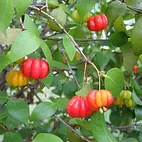
Surinam Cherry
Eugenia uniflora
NEMBA category
English: Surinam Cherry, Brazilian Cherry
Afrikaans: Pitanga
Eugenia uniflora, commonly known as the Brazilian Cherry, is a small, evergreen tree with glossy, leathery leaves and attractive, edible fruits. While the fruits are edible for humans, this species is considered invasive in South Africa, where it invades coastal forests and displaces native vegetation.


Have you got a better picture?
If you don't mind us using it, please upload it by clicking the Upload button below (you must be logged in to do this)
Origins: South America (Brazil, Uruguay, Argentina)
Overall Appearance: An evergreen shrub or small tree up to 10 meters high that can form dense thickets.
Leaves: Opposite, simple, oval to lance-shaped, glossy dark green above, paler below. Young leaves may be bronze-colored.
Flowers: White, fragrant flowers with numerous stamensfrom spring to summer.
Fruits: Fleshy, juicy, orange-red to dark purple, 8-ribbed berries.
Seeds: 1-3 seeds per fruit.
Bark: Smooth, grey-brown bark.
Wood: Hard, dense wood.
Soil Type: Tolerates a range of soil types.
Aspect: Full sun to partial shade.
Edible Parts: Fruits are edible and can be eaten fresh or used to make jams, jellies, and juices.
Birds Attracted: Attracts birds that consume the fruit, such as pigeons, doves, and some fruit-eating birds.
Insects Attracted: Attracts bees and other pollinators to the flowers.
Mammals Attracted: Some mammals may consume the fruit.
Provinces Affected: Coastal areas of South Africa, particularly KwaZulu-Natal and Eastern Cape.
Note: Surinam Cherry is a highly invasive species in South Africa. It invades coastal forests, displacing native vegetation and reducing biodiversity. It can form dense thickets that shade out native plants and alter the structure of the forest.
Friendly alternatives:

Common name
Scientific Name
Plant type:
Plant type
Plant family:
Plant family (derivation)