
Mulberry
Morus alba
NEMBA category
English: Mulberry, Common Mulberry, White Mulberry, Silkworm Mulberry
Afrikaans: Witmoerbei
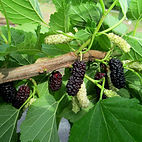
Morus alba, commonly known as the White Mulberry, is a deciduous tree native to China. It is characterised by its broad, lobed leaves, small greenish flowers, and sweet, edible berries that range in colour from white to pink or purple when ripe.
While cultivated for its fruit and as a host plant for silkworms, it is considered an invasive alien species in South Africa. It spreads rapidly through bird-dispersed seeds and can colonise riverbanks, forests, and disturbed areas, out-competing native vegetation. Its ability to thrive in a variety of conditions and its aggressive growth make it a threat to local biodiversity, particularly in riparian ecosystems.


Have you got a better picture?
If you don't mind us using it, please upload it by clicking the Upload button below (you must be logged in to do this)
Origin:
Native to China, where it has been cultivated for thousands of years.
Distinguishing features:
Variable leaf shapes: Leaves are simple but can be unlobed (heart-shaped or oval) or deeply lobed (often with 2-5 lobes) on the same tree or even the same branch.
Milky sap in leaves/stems: When a leaf or stem is broken, it exudes a white, milky, non-toxic sap.
Sweet, edible berries: Clusters of small, fleshy, juicy fruits that ripen to white, pink, or purplish-black, resembling elongated blackberries.
Fast-growing, multi-stemmed habit: Often grows quickly and can develop multiple stems from the base.
Overall appearance:
A fast-growing, deciduous tree that can grow into a large shrub or small to medium-sized tree with a dense, spreading, somewhat rounded crown. Its foliage is lush green during the growing season.
Height:
Typically grows to between 10 and 20 metres tall, but can be kept smaller with pruning.
Width:
The crown can spread between 8 and 15 metres wide.
Leaves:
Alternate, simple, and highly variable in shape, even on the same branch. They can be unlobed (oval to broadly heart-shaped) or deeply lobed with 2 to 5 irregular lobes. The margins are coarsely toothed, and the leaf surface is smooth or slightly rough, shiny green above and paler below. They measure about 5 to 15 centimetres long. When a leaf stalk is broken, a white, milky sap is exuded. Leaves turn yellow before falling in autumn.
Flowers:
Small, inconspicuous, greenish-yellow, and borne in pendulous (hanging) or upright, catkin-like clusters (spikes), about 1 to 2.5 centimetres long. Morus alba can be monoecious (male and female flowers on the same tree) or dioecious (male and female flowers on separate trees), though many cultivated varieties are monoecious. The male flowers are in looser, longer catkins, while female flowers are in denser, shorter spikes. Pollination is primarily by wind.
Flowering season:
In South Africa, it typically flowers in spring, around September to October, just as the new leaves emerge.
Fruits:
Fleshy, composite fruits that develop from the cluster of female flowers. They resemble elongated blackberries, about 1 to 2.5 centimetres long. Initially green, they ripen to white, pink, or purplish-black, becoming very sweet and juicy. The fruits are consumed by birds and mammals.
Seeds:
Small, oval, light brown seeds contained within the fleshy fruit. They are viable and readily dispersed by birds and other animals that consume the berries.
Bark:
On young stems, the bark is smooth and greyish-brown. On mature trees, it becomes shallowly furrowed and ridged, often with a slightly orangish-brown inner bark revealed in the fissures.
Thorns:
This species does not have thorns.
Wood:
The wood is relatively soft, light yellow to reddish-brown, and durable. It is used for furniture, sports equipment, and firewood.
Roots:
Develops a strong, shallow, and spreading root system. It can also produce root suckers, especially if the tree is damaged or cut back.
Soil type:
Highly adaptable to a wide range of soil types, including poor, sandy, loamy, or clay soils. It tolerates dry conditions once established and is also tolerant of various pH levels (acidic to alkaline).
Aspect:
Prefers full sun for optimal growth and fruit production. It is highly tolerant of heat, drought, and urban pollution.
Ediblity:
The ripe fruits are sweet and edible for humans, often eaten fresh or used in jams, pies, and wines. The unripe fruits and other parts of the plant are considered mildly toxic and can cause stomach upset.
Toxicity:
While the ripe fruits are edible, unripe fruits, leaves, and other parts of the plant contain a milky sap (latex) and alkaloids that can cause mild gastrointestinal upset (nausea, diarrhoea, bloating) if ingested in large quantities by humans or livestock. The sap can also cause skin irritation in some sensitive individuals.
Uses:
Historically, the primary use of Morus alba has been for sericulture (silkworm cultivation), as its leaves are the sole food source for silkworms (Bombyx mori). It is also widely cultivated for its edible fruits, which are popular for fresh consumption and processing. It is used as an ornamental and shade tree in gardens and urban landscapes due to its fast growth and attractive foliage. Its wood is used for various purposes, and extracts from the plant have been used in traditional medicine.
Ecology:
As an alien invasive plant in South Africa, Morus alba spreads aggressively from gardens and cultivated areas into natural ecosystems. Its prolific production of highly viable seeds, which are readily dispersed by birds (a major dispersal agent), contributes significantly to its invasive success. It also spreads vegetatively through root suckers and stem fragments. It forms dense stands, particularly in disturbed areas, roadsides, riparian zones (riverbanks), and forest margins, outcompeting indigenous vegetation for light, water, and nutrients. This leads to a reduction in native plant diversity and alters the structure of invaded habitats.
Distribution and habitat:
Widely cultivated throughout South Africa and has become extensively naturalised and invasive in all provinces, particularly in warmer, higher rainfall areas. It is very common in the Eastern Cape (frequently found along roadsides, in urban open spaces, and along riverbanks around Kenton-on-Sea), KwaZulu-Natal, Mpumalanga, Limpopo, Gauteng, and Western Cape. It invades disturbed sites, roadsides, urban open spaces, forest margins, riparian zones, and neglected farmlands.
Derivation of name:
The genus name Morus is the classical Latin name for the mulberry tree.
The species epithet alba is Latin for "white," referring to the white or pale colour of its fruits, which distinguishes it from other mulberry species that typically have darker fruits.
Common names like "White Mulberry" and "Silkworm Mulberry" directly refer to its fruit colour and its primary historical use.
Historical aspects:
Morus alba has a history spanning thousands of years, primarily linked to the origins of sericulture in China. It was introduced to numerous parts of the world, including South Africa, to support silkworm farming and for its edible fruits. Its hardiness, fast growth, and ability to thrive in various conditions made it a popular choice. However, these same traits, combined with its prolific seed production, ultimately led to its escape from cultivation and establishment as a significant invasive species in many regions globally, including South Africa.
Interesting facts:
This tree is the ultimate fast-food restaurant for silkworms! Its leaves are the only thing silkworms eat, making this tree super important for producing silk!
It's a bit of a shape-shifter: the leaves on one branch can be completely different shapes, from plain ovals to deeply lobed, like a hand with fingers!
While its berries look like small, pale blackberries, they can be white, pink, or even dark purple when ripe, and they're super sweet and juicy!
The White Mulberry is often a "pioneer" plant, meaning it's one of the first trees to pop up in disturbed areas like old fields or roadsides, thanks to all those birds spreading its seeds!
Friendly alternatives:

Common name
Scientific Name
Plant type:
Plant type
Plant family:
Plant family (derivation)