
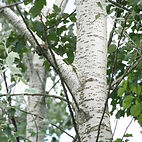
White Poplar
Populus alba
NEMBA category
English: White Poplar, Silver Poplar, Abele
Afrikaans: Witpopulier
Historical scientific names: Populus bolleana, Populus nivea
Populus alba, commonly known as the White Poplar, is a fast-growing, medium-sized deciduous tree with a distinctive silvery appearance. This shimmer comes from the underside of its leaves, which are covered in a dense, white, felt-like layer, contrasting beautifully with the dark green upper surface.
When mature, it typically has pale, smooth bark, becoming rougher with age. It produces long, dangling catkins (flower clusters) in spring, followed by tiny, fluffy white seeds that look like cotton wool, which are easily dispersed by wind.


Have you got a better picture?
If you don't mind us using it, please upload it by clicking the Upload button below (you must be logged in to do this)
Origin:
Native to central and southern Europe, North Africa, and central Asia.
Distinguishing features:
Two-toned leaves: Leaves are dark green and smooth above, but intensely white and hairy (felty) below, giving a striking contrast when the wind blows.
Aggressive root suckering: Produces numerous shoots (suckers) from its root system, often far from the main trunk, leading to dense, clonal thickets.
Pale bark: Smooth, pale greenish-grey to whitish bark on younger stems and branches, becoming more fissured and darker with age.
Distinctive leaf shape: Leaves are often lobed, resembling a maple leaf or sometimes more oval with wavy edges.
Catkins (flowers) before leaves: Male and female catkins appear in early spring before the leaves emerge.
Overall appearance:
A medium-sized, deciduous tree with an upright, spreading, or rounded crown. Its most characteristic feature is the silvery-white underside of its leaves, which flash prominently in the wind, and its often pale bark. It frequently forms dense stands due to prolific root suckering.
Height:
Typically grows 10 to 20 metres tall, but can sometimes reach up to 25-30 metres in optimal conditions.
Width:
Can spread widely due to its suckering habit, forming groves or thickets many metres across. A single tree's crown can be 8 to 15 metres wide.
Leaves:
Deciduous, alternate, and typically lobed, somewhat resembling a maple leaf, or sometimes oval with wavy, toothed margins. They are dark green and smooth on the upper surface, but strikingly covered in dense, white, felt-like hairs on the underside, which gives the tree its silvery appearance. The leaves are 4 to 10 centimetres long and have flattened petioles (leaf stalks) that cause them to flutter in the breeze.
Flowers:
Male and female flowers are borne on separate trees (dioecious) in drooping catkins.
Male catkins: Reddish-brown, stout, 3 to 7 centimetres long, releasing pollen.
Female catkins: Greenish, more slender, 5 to 10 centimetres long. They appear in early spring before the leaves emerge.
Flowering season (South Africa):
Flowers in early spring (around August to October), before the new leaves fully develop.
Fruits:
Small, green, two-valved capsules, about 5-8 millimetres long, borne in the female catkins. They split open to release seeds.
Seeds:
Very small, light, and numerous, each surrounded by a tuft of long, cottony white hairs. These hairs allow the seeds to be carried long distances by wind and water. The fluffy white 'cotton' can be quite noticeable when seeds are released.
Bark:
On young stems and branches, the bark is smooth and pale greenish-grey to whitish, often with dark, diamond-shaped lenticels (pores). On older trunks, the bark becomes darker (greyish-brown), rougher, and deeply fissured, especially at the base.
Wood:
Soft, light, and relatively weak. It is used for pulp, matches, light construction, and plywood.
Roots:
Develops a strong, shallow, and aggressive lateral root system that produces numerous suckers (new shoots) from the roots. This suckering ability allows the tree to spread vegetatively over large areas, forming dense, clonal thickets.
Soil type:
Highly adaptable but prefers moist, well-drained, deep soils. It tolerates a wide range of soil conditions, including sandy, loamy, and even heavy clay soils, and can tolerate both alkaline and acidic conditions. It thrives in riparian (riverbank) environments.
Aspect:
Prefers full sun but can tolerate partial shade. It is very hardy and tolerant of a wide range of environmental conditions, including drought once established, wind, and frost. It is particularly well-suited to moist or wet sites.
Edibility:
Not typically consumed by humans. The bark has been historically used in some traditional medicines.
Toxicity:
Generally considered non-toxic.
Uses:
Historically planted as an ornamental tree in parks and large gardens for its attractive foliage and rapid growth. It was also used for shelterbelts, erosion control along watercourses, and as a source of timber for pulpwood and light construction.
Ecology:
As an alien invasive plant in South Africa, Populus alba is a significant threat, especially to riparian ecosystems (areas along rivers and wetlands). It invades riverbanks, streambeds, floodplains, and wetlands, forming dense, impenetrable thickets through its aggressive root suckering. These thickets outcompete and displace indigenous riparian vegetation, reducing biodiversity and altering natural habitats. Its high water consumption can also impact water availability in dry regions. The dense growth can impede water flow during floods, causing siltation and changing river morphology. Its wind and water-dispersed seeds allow it to spread rapidly, and root fragments can also sprout new trees, making control difficult.
Distribution and habitat:
Widely cultivated and extensively naturalised and invasive across South Africa, particularly along watercourses and in moist areas. It is very common in provinces with suitable riverine habitats and higher rainfall, including the Eastern Cape (widespread along rivers and dams around Kenton-on-Sea), Western Cape, KwaZulu-Natal, Free State, Mpumalanga, and Limpopo. It invades riparian zones, wetlands, floodplains, disturbed areas, and sometimes even dry grasslands or savannas if planted.
Derivation of name:
The genus name Populus is the classical Latin name for poplar trees.
The species epithet alba is Latin for "white," referring to the distinctive white, felt-like undersides of its leaves and its pale bark.
The common name "White Poplar" directly reflects this prominent white feature.
Historical aspects:
Populus alba was introduced to South Africa many decades ago (possibly in the 18th or 19th century) as an ornamental tree, for erosion control along rivers, and for its rapid growth. Its ability to thrive in moist conditions and its prolific suckering made it seemingly ideal for stabilising riverbanks. However, these very characteristics, combined with its abundant wind-dispersed seeds, allowed it to escape cultivation and become a widespread and aggressive invader of natural riparian ecosystems, leading to its declaration as an invasive species.
Interesting facts:
This tree is a fashionista! Its leaves are dark green on top, but underneath, they're covered in a super soft, white fuzz – so when the wind blows, the tree looks like it's sparkling silver!
It's a bit of a sneaky spreader; it doesn't just grow from seeds, but also sends out new shoots from its roots, sometimes metres away from the main tree, creating a whole forest of itself!
When its seeds are ready to fly, they float on fluffy white 'cotton' in the air, making it look like it's snowing, even in summer!
Because it loves water so much, it's often found hanging out by rivers and streams, but that's also why it's such a problem – it drinks up too much precious water from our ecosystems!
Friendly alternatives:

Common name
Scientific Name
Plant type:
Plant type
Plant family:
Plant family (derivation)