
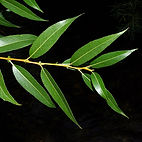
Crack Willow
Salix fragilis
NEMBA category
English: Crack Willow, Brittle Willow
Afrikaans: Kraakwilger
Salix fragilis, commonly known as Crack Willow, is a large, fast-growing deciduous tree with an irregular or rounded crown and often several main stems. Its bark is typically grey-brown and deeply furrowed on older trees. Its leaves are long, narrow, lance-shaped, glossy green, and have finely toothed edges. In spring, it produces slender, yellowish-green, fuzzy flower clusters called catkins.
This tree gets its common name "Crack Willow" because its branches are notoriously brittle, snapping off easily at their bases, especially during storms or strong winds. These broken branches readily root in moist soil or water, making it a very aggressive alien invasive species in South Africa. It forms dense stands along rivers, dams, and wetlands, consuming vast amounts of water and displacing indigenous riparian plants.


Have you got a better picture?
If you don't mind us using it, please upload it by clicking the Upload button below (you must be logged in to do this)
Origin:
Native to Europe and western Asia.
Distinguishing features:
Brittle branches that 'crack' easily: A key characteristic; branches and twigs snap off very readily at their bases with a distinctive cracking sound, particularly when bent or during wind.
Rapid rooting from broken branches: Detached branches or twigs root extremely easily when they fall into water or moist soil, leading to rapid vegetative spread.
Large, often multi-stemmed tree: Grows into a substantial tree, frequently with several main trunks, and can form dense clonal groves.
Long, narrow, glossy green leaves: Leaves are lance-shaped, shiny green above, and slightly paler below, with finely toothed margins.
Prefers water (riparian habitat): Almost exclusively found growing close to water sources (rivers, dams, ponds, wetlands).
High water consumption: Known for its significant water usage due to its fast growth and high transpiration rates.
Overall appearance:
A large, fast-growing, deciduous tree, often multi-stemmed, with a broad, rounded, or irregular crown. It is typically found near water bodies, and its branches often show signs of snapping easily.
Height:
Typically grows 15 to 25 metres tall, but can sometimes reach up to 30 metres.
Width:
Can spread 10 to 20 metres wide, forming extensive clonal stands due to its prolific vegetative reproduction.
Leaves:
Deciduous, alternate, simple, and narrowly lance-shaped, 9 to 15 centimetres long and 1.5 to 3 centimetres wide. They are glossy bright green on the upper surface, paler and hairless or slightly hairy on the underside, with finely serrated (toothed) margins. They turn yellowish in autumn.
Flowers:
Small, yellowish-green, inconspicuous flowers are borne in slender, cylindrical, fuzzy clusters called catkins, typically 2 to 6 centimetres long. Male and female flowers are borne on separate trees (dioecious), but many cultivated forms are male.
Flowering season (South Africa):
Early spring (around August to October), as the leaves begin to emerge.
Fruits:
Small, greenish capsules (if female trees are present), which split to release tiny, cottony seeds. However, fertile seed production is uncommon in cultivated Crack Willows, with vegetative spread being the primary method.
Seeds:
Very small, light, and numerous, each surrounded by a tuft of long, cottony white hairs. These allow for wind and water dispersal, but vegetative reproduction from broken branches is far more significant in its invasive spread.
Bark:
On young stems and branches, the bark is smooth and greenish-brown. On older trunks, it becomes grey-brown to dark grey, thick, and deeply furrowed with intersecting ridges.
Wood:
Soft, light, and brittle. It is not typically used for high-quality timber but can be used for pulp, firewood, and some rough construction.
Roots:
Develops an aggressive, extensive, and shallow root system that spreads widely in search of water. These roots are known to invade and block drains, pipes, and septic tanks, and also anchor the tree in riparian zones.
Soil type:
Prefers moist to wet, deep, fertile soils, particularly in riparian environments. It tolerates periodic waterlogging and a range of soil pH, but does not do well in dry or compacted soils.
Aspect:
Prefers full sun. It is very hardy and tolerant of cold temperatures, but its primary requirement is abundant moisture. It is a pioneer species often found along water bodies.
Edibility:
Not typically consumed. The bark and leaves contain salicin, similar to aspirin, and have been used in traditional medicine.
Toxicity:
Generally considered non-toxic.
Uses:
Historically planted for erosion control along waterways due to its rapid growth and easy rooting, as well as for its wood, basketry, and as an ornamental tree in large landscapes.
Ecology:
As an alien invasive plant in South Africa, Salix fragilis is a major threat, particularly to riparian (riverine) and wetland ecosystems. It rapidly colonises riverbanks, streambeds, dams, and wetlands, forming dense, impenetrable stands that outcompete and displace indigenous riparian vegetation. Its extremely high water consumption (evapotranspiration) can significantly reduce water flow in rivers and lower water tables, impacting water availability for other plants, animals, and human use in water-scarce regions. Its brittle branches break off easily and root readily, allowing it to spread rapidly downstream and colonise new areas. Dense growth can also alter water flow, leading to siltation and changes in river morphology.
Distribution and habitat:
Widely cultivated and extensively naturalised and invasive throughout most of South Africa, particularly along watercourses and in moist areas. It is very common in provinces with suitable riparian habitats and higher rainfall, including the Eastern Cape (widespread along rivers, dams, and moist areas around Kenton-on-Sea), Western Cape, KwaZulu-Natal, Free State, Mpumalanga, and Limpopo. It invades riparian zones, wetlands, floodplains, and disturbed areas where moisture is plentiful.
Derivation of name:
The genus name Salix is the classical Latin name for willow trees.
The species epithet fragilis is Latin for "fragile" or "brittle," referring to the ease with which its twigs and branches break off.
"Crack Willow" also directly refers to this characteristic snapping sound.
Historical aspects:
Crack Willow was introduced to South Africa many decades ago (likely 18th or 19th century) as an ornamental tree and for its perceived usefulness in erosion control along waterways due to its rapid growth and ability to establish easily from cuttings. However, these very characteristics, combined with its high water usage, inadvertently led to its widespread escape from cultivation and its subsequent establishment as a major invasive species across the country, significantly impacting freshwater ecosystems.
Interesting facts:
This tree is named 'Crack Willow' because its branches are super brittle and snap off with a distinctive 'crack' – it's like a built-in self-cloning machine when bits fall into water!
It's a champion water drinker! This tree guzzles so much water that it can actually lower the water level in rivers and dams nearby, which is bad news for other plants and animals that need that water.
If you throw a broken twig from this tree into a puddle, there's a really good chance it will grow roots and become a whole new tree – that's how easily it spreads!
Unlike its famous 'weeping' cousin, this willow stands tall and proud, though its branches are still prone to dramatically snapping off!
Friendly alternatives:

Common name
Scientific Name
Plant type:
No plant types available.
Plant family:
Plant family (derivation)