
textAdminOnlyNameForClipboard
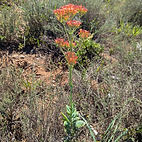
Round-leaf Kalanchoe
Kalanchoe rotundifolia
SA tree number
English: Round-leaf Kalanchoe, Common Kalanchoe, Round-leaved Kalanchoe
Afrikaans: Nentabos, Plakkie, Nentakalanchoe, Rooiblomkalanchoe, Rondeblaarplakkie
Xhosa: umFayisele yaSehlatini, iPewula
Zulu: iDambisa, uChane, uMadinsane, uMavumbuka, uMayime
Historical scientific names: Cotyledon rotundifolia, Kalanchoe globulifera var. rotundifolia, Kalanchoe elatior, Kalanchoe rotundifolia var. elatior
Kalanchoe rotundifolia, often known as the Round-leaf Kalanchoe or Plakkie, is a common and distinctive brittle succulent perennial native to Southern Africa. It is characterised by its fleshy, rounded or somewhat lobed leaves that often cluster at the base of slender, erect stems. The plant produces flat-topped clusters of small, tubular yellow or orange flowers, which are particularly interesting as they turn red and conspicuously twist as they age. It is a resilient plant, widely distributed across South Africa and parts of Zimbabwe.


Have you got a better picture?
If you don't mind us using it, please upload it by clicking the Upload button below (you must be logged in to do this)
Distinguishing features:
Fleshy, rounded or slightly lobed leaves, often clustered at the base of the stems.
Slender, erect, and somewhat brittle stems.
Flat-topped (corymb-like) inflorescences bearing numerous small, tubular yellow or orange flowers.
Flowers that remarkably turn red and develop a twisted appearance as they mature or age.
A traditional reputation among the Zulu people as a charm to make one invisible.
Overall appearance:
Kalanchoe rotundifolia is a brittle succulent perennial that typically grows upright. It forms a common sight in its natural habitats, often presenting as an herbaceous clump of fleshy leaves from which slender flowering stems emerge.
Height:
This succulent plant commonly grows up to 1 metre tall.
Width:
It can spread by means of a subterranean rootstock, forming clumps. A specific width in metres was not consistently detailed, but it forms spreading colonies over time.
Leaves:
The leaves are a key feature; they are fleshy, ranging from rounded to lobed or obovate, and are typically about 2.5 cm (1 inch) broad. They are often clustered at the base of the erect stems, though some can be alternately arranged further up the stem. The leaves are generally green but can develop reddish tints, especially when exposed to direct sun or cooler temperatures.
Flowers:
The flowers are small, tubular, and occur in colours ranging from yellow to orange. They are arranged in a flat-topped inflorescence (a corymb), creating a dense cluster. A notable characteristic is that these flowers often become red and conspicuously twisted as they age, adding an unusual visual element.
Flowering season:
The flowering period occurs through autumn and early winter, typically from February until June. As of June, Kalanchoe rotundifolia is currently in its flowering season in Kenton-on-Sea, Eastern Cape.
Fruits:
Following flowering, Kalanchoe species generally produce dry, capsule-like fruits (follicles) that split open to release their seeds. A specific detailed description of the mature fruit for Kalanchoe rotundifolia was not widely available, as the plant is primarily appreciated for its foliage and flowers.
Seeds:
The fruits contain minute seeds. Propagation from seed is known to be easy.
Stems:
The stems are slender and erect. They can be brittle, meaning they snap easily.
Roots:
It spreads by means of a subterranean rootstock, allowing it to form clumps. Detailed morphology of its roots was not specifically described.
Soil type:
It thrives in well-drained, sandy, or rocky soils. Like most succulents, it is intolerant of waterlogged conditions, which can lead to root rot.
Aspect:
Kalanchoe rotundifolia performs best in full sun to semi-shade. It is frost tender, meaning it can be damaged by cold temperatures and frost, so it should be planted in a protected location in colder climates.
Edibility:
Kalanchoe rotundifolia is not considered edible for human consumption.
Toxicity:
Like other species within the Kalanchoe genus, Kalanchoe rotundifolia contains cardiac glycosides. These compounds can be poisonous to animals, particularly pets (like dogs and cats) and livestock, if ingested. Symptoms of poisoning can include gastrointestinal upset, lethargy, and in severe cases, heart problems. Caution should always be exercised, and ingestion should be prevented.
Uses:
Ornamental: Cultivated in gardens, rockeries, and succulent collections for its interesting foliage and unique flowers.
Traditional Medicine/Cultural: Traditionally, the Zulu people are known to use this plant as a charm, particularly believed to make one invisible. Its leaves have also been used in traditional remedies for ailments like headaches and colds.
Ecology:
The flowers of Kalanchoe rotundifolia attract tiny pollinating insects, contributing to local biodiversity. Its succulent nature allows it to store water efficiently, making it well-adapted to dry and rocky environments.
Distribution and habitat:
Kalanchoe rotundifolia is widely distributed in South Africa, found in all nine provinces (Eastern Cape, Free State, Gauteng, KwaZulu-Natal, Limpopo, Mpumalanga, North West, Northern Cape, and Western Cape). It is also found in Zimbabwe. Its natural habitat includes rocky outcrops, forest margins, and other areas in grassland and bushveld biomes, often found growing in the semi-shade of trees or larger shrubs.
Derivation of name:
Kalanchoe: The genus name has an uncertain origin; it may come from a phonetic transcription of old Chinese words "Kalan Chauhuy" meaning "that which falls and grows" (referring to plantlets) or from ancient Indian words "kalanka" (rust) and "chaya" (glossy), which might allude to the reddish hue of some species.
rotundifolia: This specific epithet is derived from Latin, meaning "round-leaved," which directly describes the characteristic shape of the plant's leaves.
Historical aspects:
Beyond its documented traditional use by the Zulu people as a charm for invisibility and its general presence in traditional remedies, extensive specific historical records for Kalanchoe rotundifolia in broader cultural or scientific contexts were not widely detailed in the provided information. Its hardiness and widespread distribution suggest a long natural history in its native habitats.
Interesting facts:
Its scientific name, rotundifolia, literally means "round-leaved," which perfectly describes its distinctive, fleshy leaves!
The flowers of this Kalanchoe have a cool trick: they twist and turn red as they get older, giving them a really unique look!
In traditional Zulu culture, Kalanchoe rotundifolia has been used as a charm, with beliefs that it could make one invisible! How magical is that?
This plant is pretty common in the South African landscape, showing just how adaptable and robust it is in different environments.
As a succulent, it's a great choice for water-wise gardens because it's brilliant at storing water in its fleshy leaves and stems.
Growing tips:
Light: Plant in full sun to semi-shade for best growth. While it tolerates some shade, direct sun may enhance reddish tints on the leaves.
Soil: Requires well-drained soil. Use a sandy or rocky mix, similar to what you'd use for other succulents. Avoid heavy, waterlogged soils at all costs.
Watering: Water sparingly. Allow the soil to dry out completely between waterings. It is drought-tolerant and susceptible to root rot if overwatered.
Frost Protection: Kalanchoe rotundifolia is frost tender. In areas prone to frost, plant it in a protected spot, consider covering it during cold snaps, or grow it in a container that can be moved indoors.
Propagation: Very easy to propagate from both seed and cuttings. Allow cuttings to dry and form a callus for a few days before planting.
Maintenance: Generally low-maintenance. It does not require frequent feeding.
Placement: Ideal for rockeries, succulent gardens, dry slopes, or as a container plant.
This plant is a fantastic alternative for:

Common name
Scientific Name
Plant type:
Plant type
Plant family:
Plant family (derivation)