
textAdminOnlyNameForClipboard
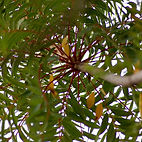
Mountain Seringa
Kirkia wilmsii
SA tree no: 269
English: Mountain Syringa, Transvaal Wild Syringa, Veld Syringa, Mountain Kirkia, Wild Pepper Tree
Afrikaans: Bergsering, Bergseringe, Wildepeperboom
Zulu: umBandaulu
Northern Sotho: Modumela
Venda: Mutovhuma
Synonyms: Kirkia pubescens
Misapplied name: Kirkia acuminata var. serrata
Kirkia wilmsii, commonly known as Mountain Syringa or Bergsering, is a beautiful, small to medium-sized deciduous tree. It's often multi-stemmed and stands out with its distinctive, fissured bark that ranges from dark grey to black, and has a rough, corky texture, especially on older parts.
Like its relative, the White Syringa, its long, pinnate (feather-like) leaves are a real showstopper, turning brilliant shades of yellow, orange, and red in autumn before they drop. While its flowers are small and inconspicuous, its autumn colours and unique bark make it a popular ornamental tree.


Have you got a better picture?
If you don't mind us using it, please upload it by clicking the Upload button below (you must be logged in to do this)
Distinguishing features:
Deciduous small to medium-sized tree, often multi-stemmed.
Bark is dark grey to black, rough, corky, and deeply fissured.
Long, pinnate (feather-like) leaves.
Leaves turn brilliant yellow, orange, and red in autumn.
Small, greenish-yellow flowers.
Produces small, woody capsules.
Overall appearance:
Kirkia wilmsii is a charming deciduous tree with a somewhat sparse, rounded crown and distinctive rough, dark bark. It is most notable for its spectacular autumn foliage, which provides a vibrant display of colour.
Height:
Typically 3 m to 7 m tall, but can reach up to 10 m in ideal conditions.
Leaves:
Pinnate (feather-like, with leaflets arranged along a central stalk).
Length up to 350 mm (shorter than K. acuminata).
Composed of 8 to 15 pairs of leaflets plus a terminal one.
Leaflets are elliptic to oblong (oval).
Leaflets are up to 60 mm long and 20 mm wide.
Arranged spirally on branches, clustered at the ends of branchlets.
Turn brilliant yellow, orange, and red in autumn before falling.
Flowers:
Small, inconspicuous.
Greenish-yellow.
Borne in slender, branched clusters (axillary panicles) up to 150 mm long.
Flowering season:
October to December (early summer), often before the new leaves are fully developed.
Fruits:
Woody, oblong capsules.
About 10 mm long.
Light brown when ripe.
Split into four valves (sections) to release seeds.
Bark:
Dark grey to black.
Rough and corky, deeply fissured (cracked), especially on older parts of the trunk.
Very distinctive, often used for identification.
Stems:
Often multi-stemmed, contributing to a broader habit.
Branchlets are often clustered.
Wood:
Soft, light.
Fine-grained, pale yellowish-brown.
Soil type:
Prefers well-drained, sandy soils, often found in rocky areas.
Aspect:
Thrives in full sun. Very hardy to drought and frost once established.
Uses:
Horticultural: An excellent ornamental tree for gardens, particularly valued for its autumn colour and interesting bark. Suitable for rock gardens and smaller gardens.
Traditional: Wood is used for local carvings and domestic implements.
Ecology:
Deciduous nature: Sheds leaves in winter, an adaptation to cold or dry seasons, helping it conserve water.
Habitat: Typically found on rocky outcrops, stony hillsides, and often on deep sand, in bushveld, grassland, and highveld regions.
Pollination: Flowers attract insects.
Distribution and habitat:
Endemic to South Africa.
Found in the Limpopo, Mpumalanga, and North West provinces.
Its habitat includes bushveld, grassland, and highveld, often in rocky areas or on deep sandy soils.
Derivation of name:
The genus name Kirkia honours Sir John Kirk (1832–1922), a Scottish physician, naturalist, and explorer.
The species name wilmsii honours Dr Friedrich Wilms (1865–1918), a German pharmacist and botanist who collected plants in South Africa.
Common names like "Mountain Syringa" refer to its preference for rocky, higher altitude habitats and its resemblance to the European Syringa in some aspects. "Transvaal Wild Syringa" and "Veld Syringa" indicate its regional occurrence and wild nature.
Interesting facts:
The Mountain Syringa is famous for its incredible autumn show! Its leaves turn a breathtaking mix of bright yellow, orange, and fiery red before they fall, making it a star in any garden.
Unlike some smooth-barked trees, this one has a really rough, corky, and deeply fissured bark that's dark grey to black – it's like a cool, textured jacket!
Even though it's called a "Syringa," it's not actually related to the common garden Syringa, making it a unique South African gem.
This tree is super tough! It's perfectly happy growing in rocky, dry places and can handle both drought and frost once it's grown up.
Growing tips:
Planting location: Kirkia wilmsii is an excellent choice for a focal point in a garden, particularly for rock gardens or areas where its stunning autumn colours can be appreciated. It's suitable for smaller gardens compared to its relative, K. acuminata.
Soil and watering: It thrives in very well-drained, sandy soils, often in rocky conditions. It's very drought-hardy once established, but regular watering when young will help it establish faster.
Aspect: Plant in full sun for the best growth and autumn colour display. It is very hardy to frost and drought once mature.
Propagation: Can be grown from seed or truncheons (large cuttings). Seeds: Sow fresh seeds. Germination can be slow. Truncheons: Large branch cuttings can be taken and planted directly, particularly in warmer, wetter months.
This plant is a fantastic alternative for:

Common name
Scientific Name
Plant type:
Plant type
Plant family:
Plant family (derivation)