
textAdminOnlyNameForClipboard
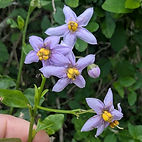
Dune Nightshade
Solanum africanum
SA tree number
English: Dune Nightshade, Dune Nightshade Climber, Drunken Berry, Drunken Rope
Afrikaans: Dronkbessie, Dronktou
Synonyms, misapplied or old scientific names: Solanum aggerum, Solanum crassifolium, Solanum exasperatum, Solanum geniculatum, Solanum quadrangulare, Solanum quadrangulare var. glabrum, Solanum quadrangulare var. integrifolium, Solanum quadrangulare var. sinuato-angulatum, Solanum bracteatum, Solanum longipes
Solanum africanum, commonly known as Dune Nightshade or Dronkbessie, is a hardy perennial creeper or shrub indigenous to South Africa. It is characterised by its trailing stems, yellow-centred purple, mauve, or white flowers, and black berries.


Have you got a better picture?
If you don't mind us using it, please upload it by clicking the Upload button below (you must be logged in to do this)
Distinguishing features:
Scrambling or climbing shrub up to 3 metres tall
Stems smooth and square when young
Leaves somewhat fleshy, lanceolate to ovate, up to 6 cm long
Flowers in terminal clusters, purple, mauve, or white with yellow centres
Berries purplish-black when ripe, approximately 15 mm in diameter
Often found near coastal dunes.
Overall appearance:
A hardy, semi-succulent shrub or climber that can sprawl prostrate or ascend with support, featuring smooth, young stems and vibrant flowers.
Height:
Up to 3 metres
Width:
Variable, depending on growth habit and support
Leaves:
Somewhat fleshy, lanceolate to ovate, with lower leaves often lobed; up to 6 cm long
Flowers:
Hanging in pendulous clusters of up to 30 flowers at branch tips.
Colours range from purple and mauve to white, all with yellow centres.
Flowering season:
January to October
Fruits:
Globose berries, approximately 15 mm in diameter, turning purplish-black when ripe
Stems:
Long trailing stems, semi-succulent, and herbaceous.
Roots:
Extensive woody rootstock.
Soil type:
Prefers well-drained, sandy soils
Aspect:
Thrives in full sun
Edibility:
The common name "Drunken Berry" suggests that the fruit may have intoxicating properties. Given the common association of Solanum species with toxicity, it's safer to assume it's not for consumption.
Toxicity:
It is likely to have intoxicating or toxic properties.
Uses:
Can be successfully utilised to cover a trellis.
Used to stabilise dunes.
Ecology:
Frequently found near coastal dunes in the bush.
Fruits are likely consumed by birds, leading to seed dispersal.
Distribution and habitat:
Endemic to South Africa, it occurs from the Cape Peninsula (Western Cape) to KwaZulu-Natal, including the Eastern Cape. It is commonly found near coastal dunes and in fynbos.
Derivation of name:
The genus name Solanum is derived from the Latin word solamen, meaning 'comfort' or 'soothing', referring to the narcotic properties of some species in the genus.
The species name africanum simply means 'from Africa', indicating its indigenous origin.
The common names "Drunken Berry" and "Drunken Rope" likely refer to the effects of ingesting the berries or the sprawling, sprawling growth habit of the plant.
Interesting facts:
This plant's common names, "Drunken Berry" and "Drunken Rope," are a bit mysterious! Do its berries make you feel tipsy, or is it just its wild, sprawling growth that looks like a tangled "drunken rope"? You'd have to be brave (and careful!) to find out.
It's a real coastal cool kid, perfectly at home along South Africa's stunning beaches, helping to hold those sandy dunes in place.
Unlike its spiny cousin, Solanum linnaeanum, this plant prefers a more laid-back, thorn-free existence!
Growing tips:
Solanum africanum is a hardy and adaptable plant, particularly suited for coastal gardens.
It can be used as a groundcover or trained to cover a trellis or wall.
It prefers sandy soil and can thrive in full sun.
Propagation can likely be done from seeds (though specific methods are not detailed on SANBI).
This plant is a fantastic alternative for:

Common name
Scientific Name
Plant type:
Plant type
Plant family:
Plant family (derivation)