African Legacy: Indigenous Plant Files - The Majestic Alexandria Cycad

Encephalartos arenarius
This week, we're focusing on a true icon of the Eastern Cape, a "living fossil" that has survived for millions of years but is now facing a modern threat: the Alexandria Cycad or Dune Cycad (Encephalartos arenarius). This magnificent plant is a stunning example of our local biodiversity, but its future hangs in the balance.

The Dune Dweller
The name arenarius comes from the Latin word for "sand" or "sandy places," which is a perfect description of this cycad's habitat. The Alexandria Cycad is endemic to a very small area of the Eastern Cape, where it grows in the sandy soil of densely wooded coastal dunes and forests. As a result of this preference for sandy soil, it's easily removed by poachers, which is the primary threat to its survival.
A Living Fossil in Peril
Cycads are often referred to as "living fossils" because they have changed very little in the last 280 million years. However, this ancient lineage is now the most threatened plant group in South Africa. The Alexandria Cycad is classified as Endangered on the IUCN Red List of Threatened Species, with an estimated population of fewer than 1,500 mature individuals remaining in the wild.
Its numbers have declined by over 50% in the last 60 years due to illegal removal for private collections and habitat destruction. All South African cycads are protected under Appendix I of the CITES Convention, which means a permit is required to own or move one.
Identifying the Alexandria Cycad
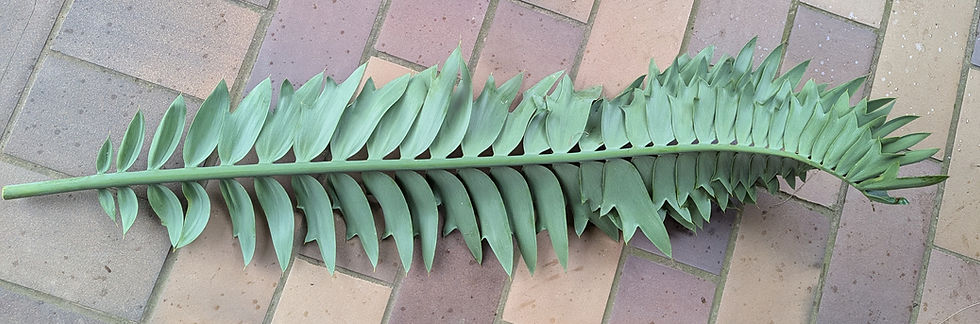
Even to the untrained eye, the Alexandria Cycad is a striking plant. It's a multi-stemmed cycad with a main stem that can reach 1-2 meters in length, often lying on the ground covered in sand. Its leaves are a dull green and can grow up to 1.5 meters long. Interestingly, there's also a rare and highly sought-after blue-leaved form found in some areas.
Breeding and Conservation
Cycads are dioecious, meaning they have separate male and female plants. The male plants produce one to three light-green cones, while the female cones are barrel-shaped and solitary.

When the female cone scales open, they reveal beautiful, shiny red seeds. Due to the scarcity of these plants in the wild, hand-pollination is often necessary to ensure a successful seed harvest for cultivation. In it's natural environment, Encephalartos arenarius cones are pollinated by specific insect vectors, typically small beetles (e.g., weevils from the family Curculionidae) which are attracted by volatile chemicals released by the cones.

By understanding the importance and vulnerability of the Alexandria Cycad, we can help protect it. This is a treasured national heritage, and its preservation is as crucial as that of our other endangered species, like the rhino.
To learn more about the Alexandria Cycad and other indigenous plants, and to see more of our images, visit its page on our website:


Comments